How to Make Your Perfume Last Longer: 7 Smart Ways to Wear It

Learning how to make your perfume last longer is not just about spraying more. A few thoughtful habits, from preparing your skin to storing your fragrance correctly, can help you enjoy your favourite scent for longer.
You find a perfume you love, apply it before leaving home, and enjoy its scent for the first hour. Then, by lunchtime, you can barely notice it.
Does that mean your perfume is weak? Not necessarily.
How long a fragrance lasts depends on several factors, including its formula, concentration, your skin, the weather, and the way you apply and store it. Sometimes, the fragrance is still there, but your nose has simply become less aware of it.
The good news is that a few thoughtful habits can help you get more enjoyment from your favourite scent without using too much or constantly reapplying it.
Here are seven practical ways to make your perfume last longer and a simple test to help you understand how it behaves throughout the day.
1. Start with Well-Moisturised Skin
One of the easiest ways to improve how your perfume wears is to pay attention to your skin before applying it.
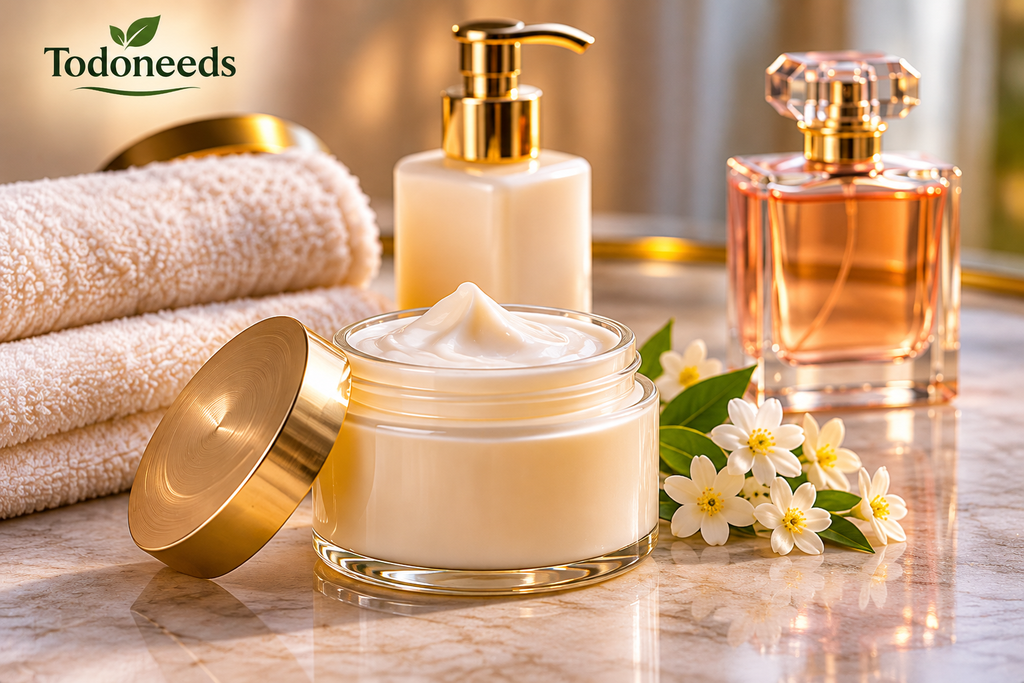
Dry skin may not hold fragrance as well as moisturised skin. A simple, fragrance-free body lotion can provide a more comfortable base for your perfume.
Try this:
- Apply an unscented moisturiser to clean skin.
- Allow it to absorb before applying perfume.
- Focus on the areas where you intend to spray.
- Avoid using a strongly scented lotion that competes with your fragrance.
You do not need an expensive product. A basic moisturiser that suits your skin is often enough.
2. Choose Your Application Points Carefully
You do not need to spray perfume all over your body. A few well-chosen areas are usually sufficient.
Common application points include:
- The sides of the neck.
- The wrists.
- The inner elbows.
- The upper chest.
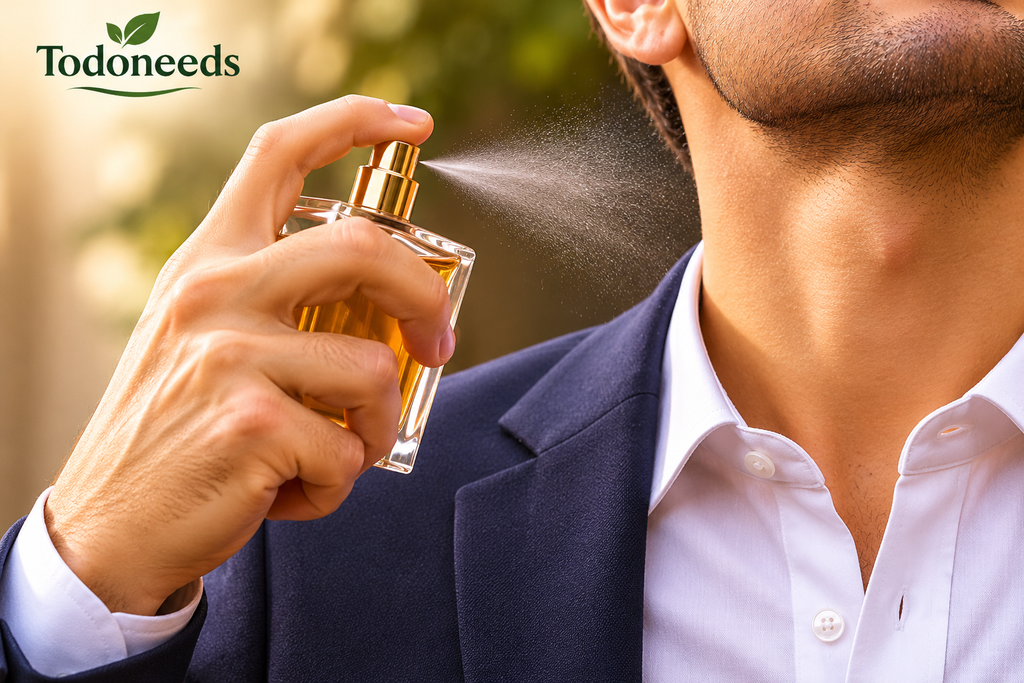
These areas can help the fragrance become noticeable as you move throughout the day.
However, there is no need to use every point at once. Choose two or three areas and see what works best for your fragrance and daily routine.
Also, avoid applying perfume to irritated or sensitive skin.
3. Stop Rubbing Your Wrists Together
It is a familiar habit: spray perfume on one wrist, press both wrists together, and rub.
But this is unnecessary.
After applying perfume, allow it to dry naturally. Rubbing creates friction and can affect how the fragrance develops on your skin.
Instead, spray each wrist separately if you want fragrance on both sides, then leave it alone.
A small change in technique can make your application more consistent.
For more insight into how fragrance interacts with your skin and why scents develop differently from one person to another, explore this guide from The Perfume Society. Understanding fragrance notes and how they evolve can help you make more informed choices when applying and wearing your favourite perfume.
4. Give Your Perfume Time to Develop
A perfume does not necessarily smell the same from the first minute until the end of the day.
Its opening notes are often the first to become noticeable. As time passes, the heart and base notes become more apparent.
This is why judging a fragrance only a few minutes after application can be misleading.
Try waiting before deciding that the scent has disappeared. Give it time to develop, and notice how it changes rather than expecting the opening smell to remain unchanged.
Understanding how fragrance develops over time is another useful way to make your perfume last longer as part of your daily routine.
A fragrance that becomes softer over time is not automatically a poor-quality fragrance.
5. How to Make Your Perfume Last Longer Throughout the Day
To make your perfume last longer, pay attention to your skin preparation, application technique, and storage habits. These small details can help you get more enjoyment from your fragrance without repeatedly spraying it throughout the day.
6. Be Careful When Applying Perfume to Clothes
Fabric can retain fragrance differently from skin, and a light application to clothing may help you enjoy the scent for longer.
However, this requires care.
Some perfumes can leave marks or affect delicate materials. Before spraying clothing:
- Check the fabric and the perfume manufacturer’s guidance.
- Test on a hidden area first.
- Avoid delicate fabrics such as silk, leather, and suede unless the product is specifically suitable.
- Never spray too close to the material.
A scarf or an outer layer may be a more practical option than spraying an expensive or delicate garment.
Remember that perfume develops differently on fabric than it does on skin.
7. Store Your Perfume Away from Heat and Light
How you store your perfume matters just as much as how you apply it.
Heat, direct sunlight, and repeated temperature changes can affect a fragrance over time. A bottle displayed on a sunny windowsill may look attractive, but it is not an ideal storage location.
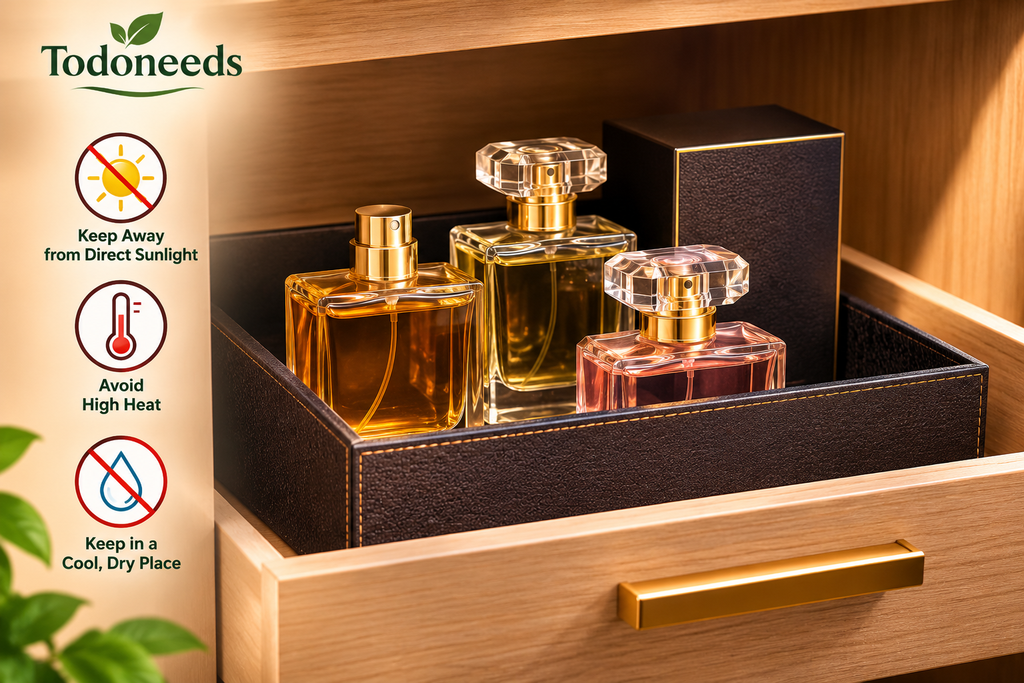
For better storage:
- Keep the bottle in its original box if practical.
- Store it in a cool, dry, dark place.
- Keep it away from windows and direct sunlight.
- Close the cap properly after each use.
- Avoid leaving it in a hot car.
- Do not keep it beside a shower or another source of frequent heat and humidity.
A closed bedroom drawer or cupboard is often a better choice than a bathroom shelf.
8. Reapply Only When You Actually Need To
One common mistake is applying more perfume simply because you can no longer smell it on yourself.
This does not always mean the fragrance has disappeared.
Your sense of smell can become accustomed to a scent that you experience repeatedly. This is sometimes called olfactory adaptation.
Before reapplying, ask someone you trust whether they can still notice your fragrance. You may discover that it is still noticeable to others.
If you genuinely need a refresh, use a small amount rather than repeating your entire morning application.
The goal is to leave a pleasant impression, not to make your fragrance overwhelming.
The One-Day Perfume Test: Find Out What Works for You
Instead of changing several habits at once, try a simple experiment with a perfume you already own.
This will help you understand how the fragrance behaves on your skin and throughout your normal day.
| Time | What to Observe |
|---|---|
| Morning | Apply your usual amount and note the first impression. |
| After 1 hour | Notice whether the scent has changed or softened. |
| After 3 hours | Check whether you can still detect it without spraying more. |
| Afternoon | Ask someone you trust whether the fragrance is noticeable. |
| Evening | Record how much of the scent remains, if any. |
Repeat the experiment on another day using moisturised skin before applying the same perfume.
Keep the application amount and your daily activities as similar as possible.
You may discover that moisturising makes a difference, that your perfume lasts longer than you thought, or that the formula itself is simply designed to be lighter.
This small test is more useful than repeatedly buying new perfumes in the hope of finding one that lasts forever.
Why Some Perfumes Last Longer Than Others
Not all fragrances are designed to have the same strength or staying power.
Concentration is one factor. Parfum and Eau de Parfum are generally more concentrated than Eau de Toilette, although actual performance varies between individual fragrances.
The scent composition also matters. Some fresh and citrus-led fragrances are designed to feel light and refreshing, while certain woody, amber, and musky compositions may remain noticeable for longer.
Your skin, the surrounding temperature, and your activity level can also influence how a perfume wears.
Therefore, a fragrance that fades sooner is not necessarily inferior. It may simply have a different character and purpose.
Final Thoughts
Making your perfume last longer is not about spraying more or buying the most expensive bottle.
It is about understanding how your fragrance behaves, preparing your skin, applying it thoughtfully, and storing it properly.
Try the one-day perfume test before changing your routine. You may find that your favourite scent performs better than you expected.
And remember: the best fragrance is not necessarily the strongest one. It is the scent that makes you feel comfortable, confident, and appropriately dressed for the occasion.
With the right habits, you can make your perfume last longer and enjoy its character throughout the day.
You May Also Like
Before choosing your next fragrance, it helps to know how to test it properly and avoid an expensive mistake.
[Before You Buy a Perfume: A Practical Test to Avoid an Expensive Mistake]
Learn how to evaluate a fragrance before purchasing it, understand how it develops, and make a more confident buying decision.