
Before You Buy a Perfume: A Practical Test to Avoid an Expensive Mistake


Before you buy a perfume, remember that a beautiful first impression is not always enough. Learn how to test a fragrance, compare your options, and decide whether a perfume is worth buying.
Buying a perfume can be surprisingly difficult. A fragrance may smell wonderful in a store, receive glowing reviews online, and still turn out to be something you rarely wear. Knowing what to look for before you buy a perfume can help you make a more confident decision.
The problem is that choosing a perfume is not just about finding a scent you like. It is about discovering whether you enjoy wearing it, whether it suits your daily routine, and whether the experience justifies the price.
Instead of relying entirely on advertisements, recommendations, or the first few seconds after spraying, try a more deliberate approach.
This guide introduces a practical three-day fragrance evaluation method you can use before committing to a full-size bottle. It is not a scientific test, and three days will not answer every question, but it gives you a more structured way to make a personal decision.
Step 1: Separate the Marketing From the Fragrance
Before you buy a perfume, consider how you will actually wear it. A fragrance may smell wonderful in a store, receive glowing reviews online, and still turn out to be something you rarely wear.
Start with three questions:
- Do I genuinely enjoy this type of scent?
- Where would I realistically wear it?
- What price would I feel comfortable paying for it?
These questions help establish your priorities before the excitement of shopping takes over.
For example, someone looking for an everyday office fragrance may value subtlety and comfort more than dramatic projection. Someone searching for an evening fragrance may prefer a richer scent.
Neither preference is better. The important thing is knowing what you want the perfume to do for you.
Step 2: Shortlist Before You Spray
Testing too many fragrances in one session can make comparisons confusing.
Begin by choosing no more than three candidates. Read their descriptions to understand the general scent direction, but treat those descriptions as clues rather than guarantees.
You might shortlist:
- One fresh or citrus fragrance.
- One woody or aromatic fragrance.
- One warm, sweet, or spicy fragrance.
This gives you a useful contrast rather than three very similar options.
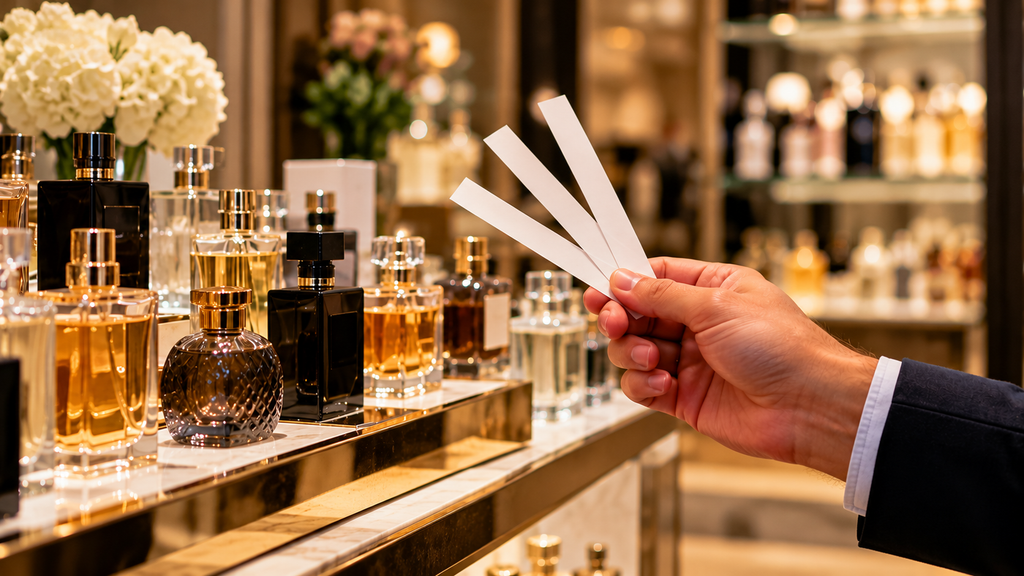
Use paper testing strips if they are available. Write the name of each fragrance on its strip so you do not mix them up.
At this stage, you are not deciding which perfume to buy. You are simply identifying which fragrances deserve a closer look.
Step 3: Day One — Look Beyond the First Impression
Choose your favorite candidate from the paper tests and try it on clean skin, following the product instructions.

Record your first impression, but do not make your final decision immediately.
Notice three things:
- The opening: Is the first impression pleasant, sharp, sweet, fresh, or something else?
- The developing scent: After some time, does the fragrance become more appealing, less appealing, or simply different?
- Your overall comfort: Do you enjoy having this scent around you, or do you find yourself wanting it to disappear?
There is no universally correct answer. A fragrance does not need to transform dramatically to be worthwhile. Some compositions remain relatively consistent, while others change noticeably as they develop.
Your job is to observe your own experience rather than assume that every perfume follows the same pattern.
Step 4: Day Two — Test It in Real Life
If a sample is available, wear the fragrance during an ordinary day rather than reserving it for a special occasion.
Use the amount you would normally apply. Avoid deliberately overspraying to make the perfume seem more impressive.
Pay attention to how it fits into your routine.
Does it feel appropriate at work? Is it comfortable in warm weather? Does it remain enjoyable when you are concentrating on something else?
If you can comfortably notice the fragrance later, consider whether you still like it. Do not assume that other people can smell it just because you can, or that a stronger scent is automatically a better one.
You may discover that a fragrance you loved in a shop feels too intense for everyday use. That is useful information, not a failed test.
Step 5: Day Three — Repeat Before You Buy a Perfume
First impressions can be influenced by mood, expectations, and the environment in which you test a fragrance.
If possible, repeat the test on another day under reasonably similar conditions.
Apply a similar amount and notice whether you still enjoy the scent. If the experience is very different, consider whether the amount applied, the setting, or the temperature might explain the difference.
Three days is a practical starting point, not a magic number. If you are still uncertain, keep the sample for longer or try it on another occasion.
The aim is to avoid confusing temporary excitement with a fragrance you will genuinely enjoy using.
Step 6: Use a Scorecard Instead of Relying on Memory
When comparing perfumes, it is easy to remember the most exciting first impression and forget the details that matter during everyday wear.
Use This Scorecard to Compare Your Perfume Choices
Use the criteria above to record your impressions after each test. Comparing your notes can help you decide which fragrance best fits your preferences, routine, and budget.
Rate each category from 1 to 5, based on your own experience.
| What to evaluate | Your question |
|---|---|
| Scent appeal | Do I genuinely enjoy the smell? |
| Everyday comfort | Am I happy wearing it for several hours? |
| Versatility | Does it suit the situations in which I need it? |
| Personal fit | Does it feel consistent with my preferences? |
| Value | Is the price reasonable for how I expect to use it? |
For example, a perfume that scores 5 for scent appeal but 2 for everyday comfort may still be an excellent occasional fragrance. It simply may not be the right choice for daily wear.
The purpose of the scorecard is not to identify an objectively perfect perfume. It is to make your priorities easier to see.
Step 7: Calculate the Cost of Actually Wearing It
Price becomes more meaningful when you consider how often you expect to use a perfume.
Imagine two hypothetical bottles:
- Bottle A costs $40 and contains 50 ml.
- Bottle B costs $80 and contains 100 ml.
Both cost $0.80 per millilitre. The more expensive bottle is not automatically worse value, nor is it automatically better.
Now consider your likely usage. If you rarely wear a particular fragrance, even a reasonably priced large bottle might sit unused for years. A smaller bottle of a fragrance you genuinely enjoy may be a more sensible purchase.
You can also compare the price of an official sample or travel size, if available, against the cost of buying the full bottle immediately.
This is not about finding the cheapest perfume. It is about paying for something you are likely to enjoy using.
To learn more about fragrances and their role in everyday products, explore the International Fragrance Association’s guide to fragrance.
Step 8: Know When Not to Buy
Sometimes the smartest decision is to wait.
Do not buy a full-size bottle simply because it is discounted, because someone compliments the fragrance, or because you feel pressured to decide before leaving the store.
Consider waiting if:
- You only liked the opening but have not worn the fragrance.
- You are unsure whether it suits your daily routine.
- You are comparing several similar perfumes and cannot remember their differences.
- The purchase would stretch your budget.
- You like the idea of owning the perfume more than the experience of wearing it.
A fragrance that remains attractive after thoughtful testing is a stronger candidate than one chosen entirely on impulse.
The Todoneeds Takeaway
Finding a perfume you love does not require an expert nose, an enormous collection, or an expensive shopping trip.
It requires a little patience and a clearer understanding of your own preferences.
Shortlist a few options, test one carefully, wear it during ordinary life, record your impressions, and compare the experience with the price. If you remain uncertain, give yourself more time.
Most importantly, remember that perfume is personal. There is no universal winner, and you do not need to justify your choice through trends or other people’s opinions.
The best fragrance purchase is not necessarily the perfume everyone notices. It is the one you are happy to reach for again.
Your turn: Have you ever bought a perfume you loved in the store but rarely wore afterward? Think about what disappointed you. That answer might be more useful than the next fragrance advertisement you see.Discovering your preference could be the first step toward finding your signature scent.
YOU MAY ALSO BE INTERESTED IN THE FOLLOWING:
– Easy Tips for Finding the Best Hairstyle for Your Face Shape and Makeup Look.
– 12 BEST WINTER PERFUMES AND FRAGRANCES.


